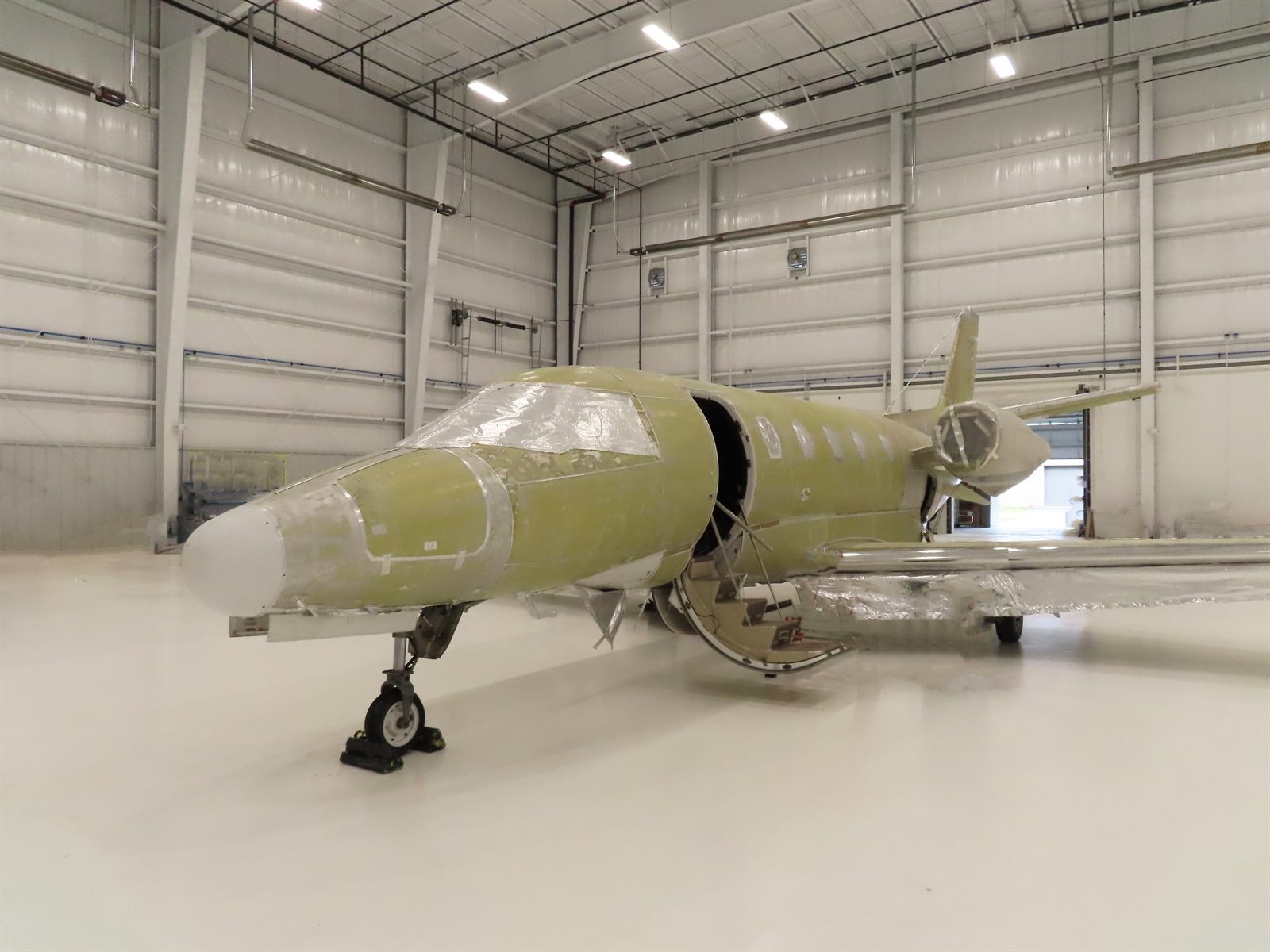
A repaint looks like a cosmetic decision. It is mostly a corrosion inspection that happens to end in a colour.
Taking an aircraft back to bare metal exposes everything the old scheme was covering: filiform corrosion along fastener lines, previous filler, sealant that has gone hard. That is why the strip is scheduled as inspection time rather than prep time, and why the honest answer to “how long will it take” is always “after the strip we will know”.
The sequence
- Strip and mask. Chemical or media strip, control surfaces removed and handled separately.
- Inspect. Corrosion mapping, fastener condition, skin-lap sealant.
- Fill and fair. The step that decides whether the finished aircraft looks poured or looks painted.
- Prime. The layer nobody sees and every subsequent layer depends on.
- Shoot and clear. Base scheme, then stripes, then registration marks.
- Rebalance and reinstall. Control surfaces are re-weighed and re-balanced — paint is mass.
Why the last step is not optional
Paint adds weight in exactly the places where weight matters most. Control surfaces come off, get painted separately, and get re-balanced to specification before they go back on. A shop that skips it produces an aircraft that looks correct and flies wrong.
Scheme design, current capacity and the interior program that usually runs alongside a repaint are on the Painting & Coating and Interior Refurbishment pages.